Developed Pedagogies

Since beginning this blog, my knowledge in the topic ethno-mathematics has developed greatly. Not only ethno-maths, but it has allowed me to picture myself in the maths classroom on more then one occasion and that has given me an insight into what I would do if I were a math teacher, and what strategies and teaching methods I would use.

I feel as though culture is such an important aspect of life and so therefore I feel like it most definitely has a place within the classroom. At first, I thought, maths is so universal, it uses number systems and I don’t see how it could ever relate to culture, but now after researching, watching videos and interviewing mathematics teachers, I have learnt a lot, and I can see that there is definitely a spot for it within the classroom.

I agree with a response from Sa Danh, the interviewee from previous blog posts, in saying that it is important to understand the cohort of students you have within your class and to implement culture from there. In knowing the student cohort you could personalise the learning experiences for the students and therefore they will be more inclined to engage and understand in the learning.

As part of my developing pedagogy, I would personalise tasks and give students choices, I would choose meaningful tasks for the students, a favourite of mine as suggested in earlier posts, is connecting the cultural music from different students backgrounds to maths used in the classroom, and I would also use these strategies ultimately to develop students understanding in the tasks. I feel as though engagement leads to understanding and then students are taking that learning experience away with them.

Within a culturally responsive classroom, students have their identity, they recognise diversity and they can link their experiences and their lives to the work they do in the maths (and any), classroom for life long learning. I can see where I would start to implement culture within HPE and science classrooms now that I have discussed it in more depth, especially the HPE classroom when out doing prac lessons and seeing what cohort of students are in the class to relate culture back to sports in the classroom as well.

I know my pedagogy will continue to grow and develop over the years, but I am slowly grasping the important aspects of teaching and the whole bunch of strategies required to ensure students are reaching their fullest potential.

‘Growth’
Photo by Akil Mazumder on Pexels.com

Interview with a Maths Teacher

Sa Danh is a Maths, Science and HPE teacher in a high school in Adelaide’s west! He has an interest in statistics and probability and the reason being, he can utilise this throughout all subjects he teaches.

It was really interesting having a conversation with him, and about 5 other maths and science teachers whilst on placement, especially when I bought up the topic about ethno-mathematics, to their response, whaattt??

I had never heard of the term together before myself, but I am not a maths teacher, so it was surprising to hear that 5 experienced teachers also had not heard the concept. Once I broke the words down and explained it, they all reacted with ‘ohhhhh yes that makes sense now’.

Having in depth conversations with them, and also going through interview questions with Mr. Danh was eye opening, especially because I don’t have much experience in the classroom just yet!

Knowing that Mr. Danh didn’t have a lot of experience with ethno-mathematics himself, it was really informative to hear his responses to some of the questions with his spin on things.

The interview went as follows…

  1. How would you describe your mathematical pedagogy and how would you apply it?

    I aim to provide students with learning opportunities beyond the textbook. Maths is traditionally textbook but I often find that students can become easily disengaged. I like to mix that up with a lot of group work and having students work as academic peers (creating their own questions for each other, marking each others’ work, explaining concepts, etc). try to find as much context to the real world as possible within the mathematics curriculum. Students will engage more effectively if they can identify the use of these concepts outside of the classroom – this might mean that we spend time outside of the classroom to facilitate learning episodes.

  2. In what other ways do you utilise mathematics outside of the maths classroom? could be either in another class or outside in the real world…

    Health and Physical Education is my major – we often use statistics and data analysis within our PE curriculum. This includes collecting data, analysing and interpreting data, while also identifying limitations within this data. Likewise in science. Numbers and maths are used in a plethora of ways in the real world – concepts within the curriculum come up in building, finance, design, sport, travelling – just to name a few.

  3. After having explained what the term ehtno-mathematics means and stands for I asked; Have you used this term throughout any of your classes before (maths or other)?

    This term specifically has not been used – however intercultural understanding is embedded within curriculum both within the AC and SACE through the general capabilities. The general capabilities has become a focal point for curriculum development in recent times and the importance of implementing them within task design continues to grow. As a result, we are seeing rich tasks being developed through the lens of intercultural understanding. This means finding ways to assist students in developing their own values and beliefs, while being appreciative of those others. This allows students to identify commonalities that they might not have been previously aware of, while also creating connections through the differences they possess, ultimately cultivating mutual respect and understanding.

  4. It is said that a basic understanding of ethno-mathematics allows teachers to expand their mathematical perceptions and more effectively instruct their students, do you agree with this? lets discuss…

    Implementing an ethno-mathematic approach in a classroom would allow students to explore their own and others’ identities through numerical concepts and understanding. This would expand the base at which the students can relate to the content, which in turn engages them further into the learning. Thus allowing teachers to promote greater intellectual stretch through their instructional processes.

  5. Teachers and the general public usually would not say that mathematics and culture are connected, Discuss this statement.

    When considering mathematics the first thing that usually comes to mind is processes pertaining to numbers. To many, numbers are acknowledged as a universal language of sorts. There is no language barrier when dealing with numbers, everyone counts on their fingers the same. I suppose this is why people often fail to draw a link between culture and mathematics – because of the commonalities of working with numbers across all demographics.

  6. It is also said that when teachers do acknowledge a connection between culture and mathematics, that students are engaged in multicultural activities, often, only because the teacher doesn’t understand fully how to achieve this and the activities don’t really link to classroom content. How would you invite culture into the mathematics classroom?

    The first way to invite culture in a classroom would be to recognise the uniqueness of the cohort. By encouraging identity awareness and acceptance in students. By doing this, students feel free to express themselves and their values. By sharing these values, other students can gain an appreciation of the various other identities and values that are present within their learning environment.

  7. Have you ever thought about the link between culture and mathematics, if so how? If not, why?

    Not to the extent that I have currently during this interview process. I think perhaps due to reasons like I have mentioned before – the fact that numbers can be considered a universal language.

  8. Do you think that there is a link with culture and maths, and how would you apply this to your pedagogy and classroom teaching practices?

    The link to culture and maths is that while mathematical expressions use universal symbols, mathematical knowledge and application has its own origin within different cultures. This can be explored by providing diverse contexts and cultural perspectives within the classroom – perhaps looking into the mathematical processes from a historical context and instances in the past where they have been used.

  9. Would you be interested in using ethno-mathematics in your classroom? and if so how would you go about achieving this?

    I would be interested. To be honest I would need to look more deeply into ways to implement this, however if the research suggests that it will improve student learning outcomes then I would definitely consider this. Accessing modern technologies would be an effective way of achieving this to explore digital learning environments that provide students with problems across different cultures and contexts.

  10. Do you agree that ethno-mathematics has a place inside the maths classroom?

    Yes!!

  11. Anything else you would like to add? Either about ethno-mathematics, or your own mathematics work, being a maths teacher, the curriculum, your pedagogy, anything..?

    Often as Maths teachers, we find ourselves under a lot of curriculum pressure. The amount of content that is require to be covered in the Australian Curriculum can sometimes feel quite difficult to fit into a semester/year. As a result, implementing strategies based on unfamiliar ideas (such as ethno-mathematics) might be discouraged. However, there is also a common issue within teaching maths of students being unable to identify or appreciate the context of which the content is delivered. Perhaps ethno-mathematics could be an effective way of providing students with authentic learning experiences that engage them in maths curriculum, ultimately leading to improved student outcomes. If this is the case, incorporating ethno-mathematics would definitely be included in my pedagogical approach.
Image result for interview

I absolutely agree with the responses Mr. Danh has given in regards to implementing ehtno-mathemathics in the classroom.

Thank you Mr. Danh for the insightful look into being a mathematics teacher and your opinion on the use of ethno-mathemtics in and out of the classroom.

It was very intuitive and I very much appreciate your precious time!

References

Bishop, A. (1990). Western mathematics: the secret weapon of cultural imperialism. SAGE Journals, 32(2). 51-65. Retrieved on 24th May 2019 from http://journals.sagepub.com/doi/abs/10.1177/ 030639689003200204

Brandt, A., Chernoff, E.J. (2015). The Importance of Ethnomathematics in the Math Class. Ohio Journal of School Mathematics, 71. Retrieved on 23rd May 2019 from https://kb.osu.edu/dspace/bitstream/handle/1811/78917/1/OJSM_71_Spring2015_31.pdf

D’ Ambrosio, U. (2001). What is Ethnomathematics and how can it help children in
schools? Teaching Children Mathematics, 7(6), 308-310.

Gay, G. (2000). Culturally responsive teaching: Theory, research, and practice. New York, NY: Teachers College Press.

Grandi, C. (2016). Origami in lessons. Artful Maths. Retrieved on 29th May 2019 from http://www.artfulmaths.com/origami-in- lessons.html

Ladson-Billings, G. (1995). Toward a theory of culturally relevant pedagogy. American Educational Research Journal, 32(3), 465-491.

NCTM (1991). Professional Standards for Teaching Mathematics. Reston. VA: National Council of Teachers of Mathematics.

Owens, K. (2015). Many non-Western cultures have developed complex mathematical systems. Australian Academy of Science.

Rosa, M., & Orey, D. C. (2006). Abordagens atuais do programa etnomatemática: delinenando-se um caminho para a ação pedagógica. BOLEMA, 19(26), 19-48.

Rosa, M. Orey, D. C. (2011). Ethnomathematics: the cultural aspects of mathematics. Revista Latinoamericana de Etnomatemática, 4(2). 32-54

Rudder. J. (n.d.). Ethnomathematics in Australia. Retrieved on 28th May 2019 from https://aiatsis.gov.au/ collections/collections- online/digitised-collections/ethnomathematics-australia

Torres-Velasquez, D., & Lobo, G. (2004). Culturally responsive mathematics teaching and English language learners. Teaching Children Mathematics, 11, 249-255.

Watch this!

This video is of a New Zealand high school student, Takunda Muzondiwa, who is giving an extremely powerful speech at the Race Unity Speech Awards. This year the awards theme is ‘Speaking for Justice, Working for Unity’.

Yes, this video is generally about race and racism, but she does touch on culture and schooling, and how students who feel comfortable in the educational setting will achieve better results.

It’s a very powerful video and although doesn’t talk soleley about culture and maths, it is worth a listen.

If you don’t have time to watch the full video, I would recommend you at least watch between 1:40 – 3:54 minutes.

Very well said. Enjoy!

Role in the classroom

Developing, or shall I say re-developing, the curriculum is a hot topic at the moment. When looking at school reforms there is said to be a lot that needs to be changed in order so show progress, in the curriculum and content within schools. It needs to reflect the changes made within society over the past two decades. With maths being such a universal subject, it is simply advised that we develop current and culturally relevant pedagogies ‘that examine the teaching-learning process within a critical paradigm and through explicit connections between students culture and the school subject matter (D’Ambrosio 1990, Gay 2000, Ladson-Billings 1995, Rosa & Orey 2003).

There are many reports which state that connecting students lives and culture to mathematics will help them become successful with deeper understandings.

According to Torres-Velasquez and Lobo (2004), this perspective is an essential component of culturally relevant education because it proposes that teachers contextualize mathematics learning by relating mathematical content to students culture and real-life experiences.

The guidelines of the National Council of Teacher of Mathematics (NCTM 1991), highlighted the importance of building connections between mathematics and students personal lives and cultures.

In accordance to this approach, Rosa and Orey (2006), affirmed that ‘when practical or culturally based problems are examined in a proper social context, the practical mathematics of social groups is not trivial because they reflect themes that are profoundly linked to the daily.

Benefits of including ethno-maths in the classroom:

  • Helps students connect mathematical learning to their lives
  • Culturally based mathematics – expresses multiple ways of thinking
  • Mathematics is a human activity – entwined with culture
  • Removes negative connotations associated with school mathematics
  • Encourages creativity, problem solving, and multiple ways of thinking
    (Brandt & Chernoff 2015)
  • Knowledge is obtained by discovery and revelation
  • Students benefit from exploring multiple approaches to mathematics
    (Rudder n.d.)

In terms of teaching ethno-mathematics in the classroom, you could;

  • Look at how different cultures use mathematics in real life
  • Explore aspects of math from different cultural perspectives e.g. geometry
  • Get students to experiment with multiple cultural counting and number systems

These ideas can be developed upon further, however, I personally like the music example written under the ‘examples of ethnomathematics’ blog post! Students could research a culture within the classroom, for example their own culture or another student in the classroom, and from there they could search that cultures music and talk about the maths involved within different patterns, counts, pitches etc. I feel like students would really engage and perhaps not even realise they are doing maths! To me, this is how students develop a deeper understanding, by being fully entrenched in the subject!

Western vs. Cultural

How does ethno-mathematics, compare to Western mathematics..?

Ethno Western
– Culturally based mathematics
– Promotes alternative ways of understanding – Concepts are applicable to life outside of school – Includes complex mathematical systems that have evolved over time in other countries – Reduces the alienation felt by students from diverse cultures (Owens 2017)
– Considered culturally-neutral – Doesn’t allow for alternative ways of knowing – May be considered irrelevant by students – Based on pre-determined formulas – Includes the basic principles of mathematics – Abstract concepts     (Bishop 1990)

As a person who has gone through schooling, has sat in many mathematics classes and used maths in almost everything, whether that be at school or in every day life, it is interesting to see the comparisons of what is standard to me (in Western maths), compared to what ethno-maths has to offer.

I can’t really pin point a time in my schooling that I was able to connect maths to culture, and in doing so relate it to real world situations or even just to say ‘hey, did you know that music has maths in it? lets have a look’. Perhaps if my teacher was able to get our heads out of the standard text book for at least a class, and utilised examples of ‘fun, real world’ things, I would of looked at maths with a little more delight! In saying that, I do know the importance of text books in maths and the demand our Australian Curriculum has on developing mathematic skills, but some more classroom time spent linking maths to real world situations would of been handy.

*Insert picture of me having fun studying ethno-mathematics*
Disclosure: not a photo of me.
Photo by bruce mars on Pexels.com

Ethnomathematics and Indigenous Australians

Indigenous Australians were using mathematics long before it was officially founded. Many Indigenous people all around the world, as well as some of the first peoples to live on this planet, used it in unique ways and in this day we call it ancient mathematical systems.

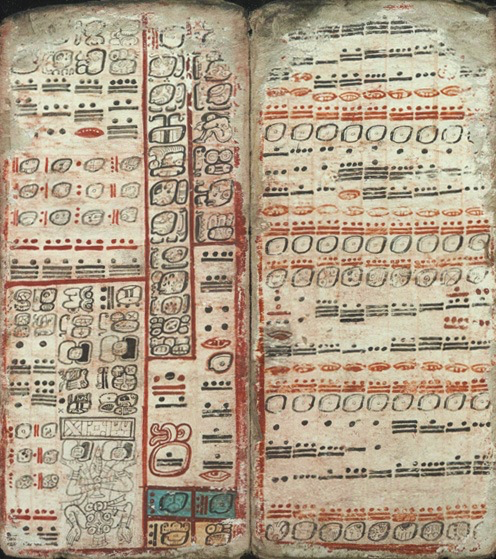
Some mathematicians believe that ancient mathematical systems remain irrelevant in this day and age, whilst others fight that it has a purpose and is still used all over the world. ‘For example, Mayans, still use traditional calendars for religious purposes and to help determine the agricultural cycle, while Indigenous groups in Papua New Guinea and Australia continue to use ethno-mathematic concepts in their everyday life’ (Owens 2015).

Part of the Dresden Codex, one of the few remaining artefacts of ancient Mayan civilisation. This portion of the Codex is almost entirely filled with Mayan numerals. Image source: Wikimedia Commons.

Traditional mathematics of Aboriginal and Torres Strait Islander peoples include counting in non-decimal systems, recognition of the patterns in relationships between clans and calendars based on natural changes in the environment. Seasons may be defined by flowering of particular plants, the activities of bees and birds and the direction of the wind.

Aboriginal people also based their ‘mathematics’ on the relationship between certain things. A classic example of this is the measurement of a spear and how that related to a person. A spear may be too long for a particular person, too short or just right. The length of the spear is thus measured relative to the user.

8 Ways -l
(The Australian Association of Mathematics Teachers – Indigenous Learners 2012) Image source:
https://www.aamt.edu.au/Indigenous-Learners/Starting-Points/Maths-as-Storytelling
The 6 Yolngu Seasons. In Yirrkala, Arnhem Land, Australia. Image source:
https://www.sbs.com.au/shows/costa/listings/detail/i/4/article/7757/Yirrkala-School-Bush-Walk

Owens, 2015, discusses the differences in Aboriginal mathematics in comparison to Western mathematics. She makes a good point, that I too could relate to, addressing that Western mathematics does not always meet the needs of all people and is not always easily understood, especially outside of ‘mainstream’ culture. A challenge presented by teachers in remote communities is that Western mathematics often has little meaning out there and it is therefore difficult to communicate. Teaching approaches that take into account the cultural context and the mathematical systems in use within the community are likely to be much more effective, as students cultural identity can be harnessed to encourage their mathematical identities.

The Aboriginal and Torres Strait Islander Mathematics Alliance (ATSIMA), exists for one, yay, but also noted that schools need to recognise mathematics in culture, celebrate and validate culture and recognise culture as mathematical.

Incorporating ethno-mathematics into the school curriculum can not only result in better grades for students, it can facilitate powerful mathematical processes such as visualising mathematical situations, encouraging a sense of proportional size, recognising mathematics in practice, making links between home and school, and encouraging relevant, daily problem solving.

There is great value, and much to be learned from the ethnomathematic principles of Indigenous cultures. By allowing ourselves to see beyond the Western numbering system, we can try to increase our understanding of not only ancient cultures, but also to see the world, and many of the mathematical problems in it, in a different, yet equally as relevant way.

What is Ethnomathematics?

Thanks for joining me for my first bog post!

What better way to understand the term, then to break it down…

To be honest, the term ethno-mathematics was not something I was highly familiar with. Prior to starting this reflective blog I only had a small understanding of the term and hadn’t further researched the area, so I thought, what better way to understand the term, then to break it down.

The term ethno describes “all of the ingredients that make up the cultural identity of a group: language, codes, values, jargon, beliefs, food and dress, habits, and physical traits.” Mathematics expresses a “broad view of mathematics which includes ciphering, arithmetic, classifying, ordering, inferring, and modelling” (D’ Ambrosio 2001).

Therefore, ethno-mathematics is the natural processes of maths that we grow up learning in school, combined with cultural traits and identities. Like myself,  it is said that ‘many educators may be unfamiliar with the term, yet a basic understanding of it allows teachers to expand their mathematical perceptions and more effectively instruct their students’ (D’ Ambrosio 2001).

blur children class classroom

‘Mathematics is a compilation of progressive discoveries and inventions from cultures around the world during the course of history. It’s history and ethnography form a wonderful mosaic of cultural contributions. Today, we too are playing a part in the evolution of the discipline of mathematics. It is time for educators to improve their understanding of the role that culture has played and continues to play in shaping mathematical development. It is time for educators to empower their students with this vital knowledge’ (D’ Ambrosio 2001).

I never thought of mathematics as having a link to culture, yet I see that this link is providing a learning connection to the real world and therefore can help people, whether that be students or adults, to form a deeper understanding of mathematics, how we use it, why we use it, and that it is in everything surrounding us on the daily. The deeper I get into researching this topic, the more I appreciate what it is and recognise its importance, especially within the classroom!

Photo by Akela Photography on Pexels.com